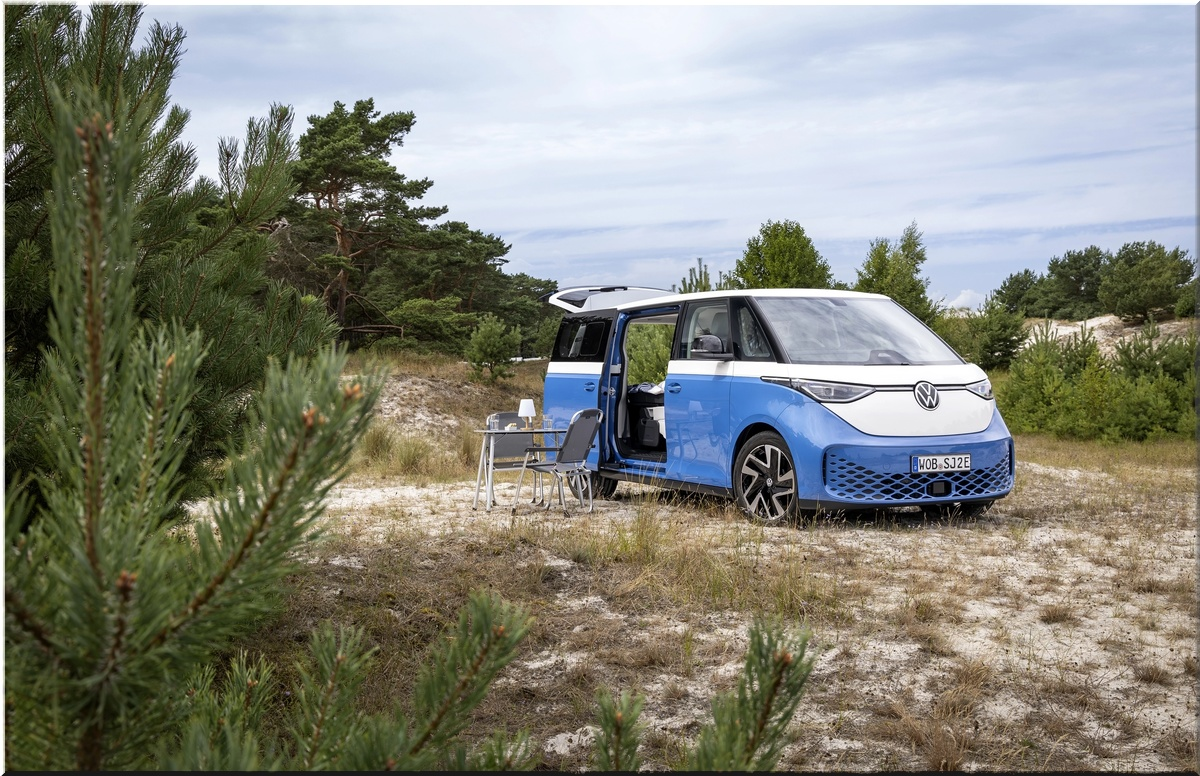
The 2027 Volkswagen ID. California Cruise marks a pivotal shift in the recreational vehicle segment. Volkswagen has officially pulled the wraps off its first fully electric California camper, a vehicle that transfers the iconic pop-top lifestyle onto the Modular Electric Drive (MEB) platform. This is not a concept car. This is a production-intent world premiere that establishes the technical benchmark for zero-emission camping.
The electric architecture fundamentally alters the packaging logic of the camper van. By eliminating the internal combustion engine and driveshaft, Volkswagen engineers unlocked a flat floor from the front seats to the tailgate. This design choice, driven by battery integration, creates interior storage capacity that rivals larger combustion vehicles. The ID. California Cruise debuts with a 82-kWh gross battery pack, a rear-mounted APP550 electric motor, and a comprehensive living module designed for four-season use.
From an expert perspective, the VW ID. California Cruise ↗ responds to a specific market demand that has been building since the ID. Buzz concept first appeared. Buyers wanted the range, the safety systems, and the modularity, but they demanded the full camper experience, not just a van with a mattress. Volkswagen’s answer is a fully integrated solution with a tilting roof, dual sliding doors, and a reimagined rear kitchen block.
The MEB Platform and Electric Powertrain Architecture
The technical foundation of the ID. California Cruise is the MEB platform, stretched to a wheelbase of 127.5 inches (3,240 mm). The vehicle measures 194.4 inches (4,939 mm) in length, 78.1 inches (1,985 mm) in width, and 77.8 inches (1,976 mm) in height with the roof closed. With the pop-top deployed, overall height increases to 86.6 inches (2,200 mm), still allowing access to most urban parking garages.
The powertrain consists of the APP550 rear-mounted electric motor. This unit produces 282 horsepower (210 kW) and 413 lb-ft of torque (560 Nm). The motor uses a single-speed gearbox and drives the rear axle exclusively. Volkswagen claims a 0-62 mph time of 8.0 seconds for the ID. California Cruise, which is remarkable given the estimated curb weight of 5,800 pounds (2,630 kg). Top speed is electronically governed at 90 mph (145 km/h).

 The motor's efficiency comes from a redesigned stator and rotor cooling system. Volkswagen moved the oil cooling circuit closer to the heat-generating components, reducing thermal losses and enabling sustained high-speed driving without derating. This matters when climbing mountain grades with a full load of camping gear and passengers.
The high-voltage battery uses lithium-ion nickel-manganese-cobalt (NMC) chemistry. Gross capacity is 82 kWh, with 77 kWh usable. Volkswagen rates the ID. California Cruise at a provisional WLTP range of 298 miles (480 km). Real-world highway driving at 70 mph typically reduces that figure by 25 to 30 percent, placing realistic range around 210 to 225 miles. The vehicle supports DC fast charging at a maximum rate of 185 kW. Charging from 10 to 80 percent takes approximately 28 minutes under ideal thermal conditions. On an 11 kW AC wallbox, a full charge requires 7.5 hours.
Battery Placement and Thermal Management
Volkswagen integrates the 82-kWh battery pack into the floor structure between the axles. The pack measures 70.9 inches (1,801 mm) in length and 55.1 inches (1,400 mm) in width. Liquid cooling uses a water-glycol mixture circulating through channels in the battery housing. The system maintains cell temperature between 68°F and 95°F (20°C and 35°C) during fast charging, which prevents lithium plating and extends cycle life.
The battery's flat design creates a completely level load floor behind the front seats. When the rear seats are folded, the sleeping surface measures 78.7 inches (2,000 mm) in length and 52.4 inches (1,330 mm) in width. That is a full-size mattress footprint. The flat floor also allows a pass-through storage tunnel beneath the rear bench, a feature impossible in combustion camper vans due to exhaust and driveshaft routing.
Thermal management for the living module operates independently. The ID. California Cruise uses a roof-mounted 300-watt solar panel to trickle-charge the 12-volt auxiliary battery that powers the interior lights, water pump, and refrigerator controls. This prevents the high-voltage battery from draining when the vehicle is parked for extended camping sessions. Volkswagen states the solar panel can recover up to 1.2 kWh per day under optimal sunlight, enough to power the refrigerator for approximately 48 hours.
The Living Module: Engineering the Camper Conversion
The camper conversion in the ID. California Cruise is not an aftermarket kit. Volkswagen designed the living module in parallel with the vehicle body, integrating structural reinforcement points and wiring harnesses during production. The result is a unified package with no visible aftermarket seams or rattles.
The signature feature is the electro-hydraulic tilting roof. The roof panel raises in 22 seconds using two electric pumps mounted in the D-pillars. The mechanism is rated for 30,000 open-close cycles, equivalent to daily use for 40 years. The pop-top tent fabric uses a triple-layer construction: an outer waterproof membrane, a breathable middle layer, and an inner mosquito mesh. The upper sleeping berth measures 78.7 inches (2,000 mm) by 47.2 inches (1,200 mm) and supports a combined weight of 330 pounds (150 kg).
The rear kitchen block occupies the tailgate area. It includes a single-burner induction cooktop rated at 1,800 watts, a 12-volt compressor refrigerator with a 1.4-cubic-foot (40-liter) capacity, and a removable 5.3-gallon (20-liter) fresh water tank. The induction cooktop draws power from the high-voltage battery through a 2.3 kW inverter, allowing cooking without shore power. A full cooking session using the induction burner at maximum output consumes approximately 0.7 kWh, reducing driving range by roughly 2.5 miles.
The front cabin transforms into a lounge area. Both front seats rotate 180 degrees on mechanical swivel bases. The rear bench slides fore and aft on rails with 9.8 inches (250 mm) of travel. A fold-out table stores in the driver-side door panel and mounts between the front and rear seats. The table measures 23.6 inches (600 mm) by 15.7 inches (400 mm) and supports 55 pounds (25 kg).
Climate Control and Off-Grid Capability
Camping in extreme temperatures requires robust climate control. The ID. California Cruise uses a heat pump system that serves both the cabin and the high-voltage battery. The heat pump achieves a coefficient of performance (COP) of 3.5 at 41°F (5°C), meaning it produces 3.5 kW of heat output for every 1 kW of electrical input. This is significantly more efficient than resistive heating, which has a COP of 1.0.
The parking climate function allows the heat pump or air conditioning to run while the vehicle is parked and the ignition is off. The system draws power from the high-voltage battery. Running the air conditioning at 68°F (20°C) interior temperature with 95°F (35°C) exterior temperature consumes approximately 1.5 kWh per hour. A fully charged battery can sustain air conditioning for roughly 51 hours, or heat for 72 hours at 32°F (0°C) exterior temperature.
The auxiliary 12-volt battery sits under the driver seat and powers the refrigerator, interior LED lighting, and water pump. A DC-DC converter steps down high-voltage power to charge the 12-volt system when the main battery is connected or the vehicle is driving. This architecture prevents a dead house battery from stranding the vehicle.
Infotainment and Digital Camper Controls
The ID. California Cruise debuts Volkswagen's new Camper Control Unit. This dedicated touchscreen interface, separate from the main 12.9-inch infotainment display, manages all living functions. The 5.3-inch display mounts on the driver-side C-pillar and controls the roof, lighting zones, refrigerator temperature, water pump, and interior climate.
The interface uses a simplified menu structure with large touch targets. Volkswagen designed the system for use with wet or cold fingers, incorporating physical buttons for the roof operation and master lighting control. The system also provides real-time battery state of charge and range remaining for both driving and camping functions.
Over-the-air software updates continuously refine the camper control logic. Volkswagen can adjust the climate control algorithms or add new features without requiring a dealer visit. The vehicle includes a dedicated 5G data connection for telematics and remote control via the Volkswagen smartphone app. Owners can pre-cool the cabin, check the refrigerator temperature, or monitor water tank levels from up to 1.2 miles away.
Pro-Tip: Maximizing Range with the ID. California Cruise
The biggest range killer in the ID. California Cruise is not the weight, the roof, or the camping equipment. It is aerodynamic drag from the roof rack and accessories. The pop-top roof adds 0.02 to the drag coefficient when closed, bringing the total Cd to 0.29. But adding a roof box or solar shower dramatically increases frontal area and reduces highway range by up to 15 percent. For maximum efficiency, stow all gear inside the vehicle when driving. The flat floor and 33.9 cubic feet of interior storage should accommodate most equipment without external racks.
Competitive Landscape: Electric Camper Van Comparison
The electric camper van segment remains small but competitive. Direct rivals include the Mercedes-Benz EQV Marco Polo, the Nissan Townstar Camper (a smaller, non-pod roof option), and the forthcoming Ford E-Transit Custom Nugget. Each takes a different engineering approach to electrification and camping integration.
Electric Camper Van Specification Matrix
SpecificationVW ID. California CruiseMercedes EQV Marco PoloFord E-Transit NuggetPlatformMEB (dedicated EV)V-Class (adapted)Transit Custom (adapted)Battery (usable)77 kWh90 kWh64 kWhWLTP Range298 mi (480 km)226 mi (364 km)196 mi (315 km)Motor Output282 hp / 413 lb-ft201 hp / 267 lb-ft181 hp / 307 lb-ftFast Charging185 kW110 kW125 kWPop-Top RoofElectro-hydraulicManual gas strutsManual gas strutsRear KitchenYes, integratedYes, integratedOptionalBase Price (USD est.)$78,000$84,500$72,000
The ID. California Cruise holds advantages in powertrain output, fast-charging speed, and the dedicated electric platform. The Mercedes EQV Marco Polo counters with a larger battery and more passenger volume, but its combustion-derived architecture compromises interior packaging and adds 700 pounds of weight. The Ford E-Transit Nugget undercuts on price but sacrifices range and lacks an integrated rear kitchen in base form.
Looking at the data, the ID. California Cruise's 185-kW fast charging is the segment's best. A 28-minute 10-80 percent charge means adding 219 miles of WLTP range in under half an hour. The Mercedes requires 40 minutes to reach 80 percent, and the Ford takes 35 minutes. For real-world camper travel, where charging stops are frequent, this difference is substantial.
Pricing and Market Positioning
Volkswagen has not announced official U.S. pricing, but the ID. California Cruise is expected to start around $78,000 when it arrives in late 2026 as a 2027 model. That positions it between the standard VW ID. Buzz ↗ (from $59,995) and the Mercedes EQV Marco Polo at $84,500.
The value equation depends on the buyer's use case. A standard ID. Buzz with an aftermarket mattress costs $62,000 but lacks the pop-top roof, integrated kitchen, solar panel, and dedicated camper climate controls. Retrofitting those features costs $18,000 to $22,000 in the aftermarket and voids the factory warranty. The ID. California Cruise's factory integration and warranty coverage justify the premium for serious campers.
Consequently, Volkswagen anticipates strong demand from existing California T6.1 owners. The brand states that 68 percent of current California owners express interest in switching to the electric model, citing reduced fuel costs and the ability to use the climate control without running a diesel engine. The electric camper eliminates the need for auxiliary diesel heaters, which are standard equipment on combustion California models and cost $1,200 to replace when they fail.
Conclusion: The Electric Camper Van Matures
The 2027 Volkswagen ID. California Cruise delivers the first fully integrated electric camper experience from a major manufacturer. The MEB platform provides class-leading fast-charging, a flat floor that maximizes interior storage, and a heat pump climate system that enables true off-grid camping. The electro-hydraulic tilting roof and dedicated Camper Control Unit set new standards for user-friendliness.
The trade-offs are clear. Range at highway speed drops to around 225 miles, requiring more frequent charging stops than a diesel California. The $78,000 starting price represents a significant investment. And the 5,800-pound curb weight demands careful attention to payload limits, which Volkswagen rates at 1,100 pounds (500 kg).
But the fundamental promise of the California nameplate—freedom, mobility, and self-sufficiency—remains intact. The ID. California Cruise simply delivers it with electrons instead of diesel. For the 68 percent of current California owners who say they want to switch, this vehicle is the answer. For everyone else, it is the first electric camper van that does not demand compromise.